Every broadcaster still paying for transponder time or long-haul fibre circuits is watching the same three pressures build. TVU's IBC 2026 pitch names them directly, and lays out a migration path that doesn't require replacing everything at once.
Three pressures on traditional contribution
Spectrum reallocation
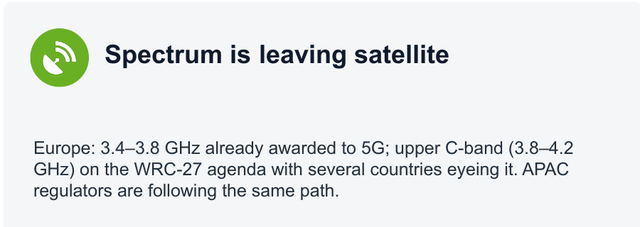
European spectrum once reserved for C-band satellite is being reallocated to 5G, with the 3.4 to 3.8 GHz range already awarded in several markets. That's spectrum broadcasters have relied on for satellite contribution for decades, and it isn't coming back.
Satellite capacity consolidation
Capacity has tightened hard since the SES-Intelsat merger, reducing the number of independent operators a broadcaster can negotiate transponder time with. Less competition in that market tends to mean less pricing leverage for anyone still buying it.
Ageing IRDs with no upgrade path
Integrated receiver-decoders deployed a decade or more ago are ageing out, and in many cases there's no meaningful upgrade path, only replacement. That's a capital outlay a lot of broadcasters have been deferring, right as the infrastructure around it gets more expensive to keep running.
TVU's answer: four layers, migrated separately
TVU's response isn't "replace your entire distribution chain with IP." It splits the workflow into four layers, contribution, routing, distribution and operations, so a broadcaster can migrate one layer at a time as budget and contracts allow, rather than facing one large capital decision.
- Contribution: bonded IP transmission from the field, replacing or supplementing satellite uplink trucks.
- Routing: MediaMesh-based pipeline routing in place of fixed satellite or fibre paths.
- Distribution: MediaHub getting content to client broadcasters without dedicated receive infrastructure at every endpoint.
- Operations: TVU NOC providing the 24/7 oversight a satellite operator would traditionally have handled.
Why the phased approach matters
Most broadcasters can't write off existing satellite contracts and IRD investments overnight, and TVU isn't asking them to. A layer-by-layer migration means the case for moving gets made on each layer's own merits, contribution first for most, with routing, distribution and operations following as contracts expire and hardware ages out naturally.
What this means locally
South African broadcasters carrying satellite contribution costs, particularly for remote or cross-border feeds, face the same spectrum and capacity pressure as anyone else on this infrastructure. KPG has supported TVU's bonded transmission and IP contribution range in South Africa for years, and can help scope which layer makes sense to move first for your workflow.