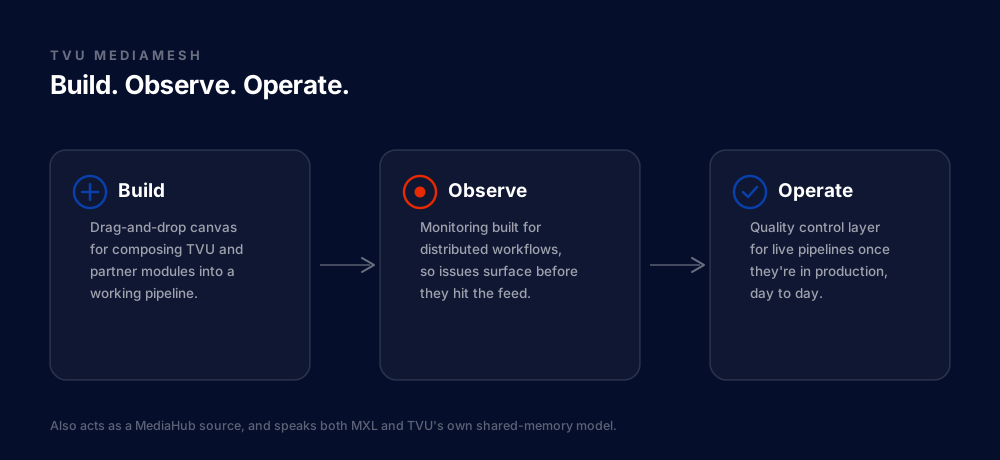
Most of TVU's headline announcements at IBC 2026, from the Reuters live workflow to the broader case for moving off satellite, run through the same underlying layer: MediaMesh. It's TVU's pipeline and routing fabric for distributed live workflows, and this year it picked up three purpose-built tools that turn it from infrastructure into something a team can actually operate.
Build: composing a pipeline without writing one
Build is a drag-and-drop canvas for assembling TVU and third-party modules into a working pipeline. Instead of hand-wiring routing, transcoding and distribution steps, an engineer lays out the workflow visually, module by module, and MediaMesh handles the plumbing underneath. That matters most when a workflow needs to change quickly, a new client feed, a different codec requirement, a temporary routing change for an event, without a re-engineering exercise each time.
Observe: monitoring for workflows that don't run in one place
A distributed live workflow doesn't fail in one obvious spot. It degrades quietly across multiple hops, a bonded path here, a transcode node there, until something visible breaks downstream. Observe is built to catch that earlier, giving operations visibility across the whole pipeline rather than a single point in it.
Operate: quality control once it's live
Operate adds the quality control layer on top, for pipelines that are already in production and need to stay that way. Between Build, Observe and Operate, MediaMesh now covers the full lifecycle: design the pipeline, watch it run, and keep it clean once it's carrying real traffic.
Plays well with others
- MediaHub source: MediaMesh now also acts as a source into TVU MediaHub, extending its reach into TVU's broader distribution stack.
- MXL compatibility: speaks the open MXL standard alongside TVU's own shared-memory model, reducing lock-in for teams mixing TVU with other vendors' tools.
Why it matters for South African broadcasters
Most local operations aren't single-vendor, and won't be. A pipeline layer that speaks an open standard and plugs into partner modules means a MediaMesh workflow doesn't box a broadcaster into TVU-only infrastructure going forward. Build, Observe and Operate are the tools that make that flexibility something an ops team can actually run, not just architect.
Where to see it working
The clearest live example of MediaMesh in production is the Reuters partnership demonstrated on the TVU stand at IBC, scaling Reuters' 24/7 global feed over IP through MediaHub and TVU NOC. Read more in our companion piece on that partnership below.